Wednesday, 24 January 2018

Have you heard about sailing round the World the wrong way ?

Steve White – round the world the wrong way 

A central Dorset sailor is planning to break the record for sailing solo the wrong way round the world next November. Steve White is an experienced solo sailor having come 8th of the 9 skippers to complete the Vendee Globe in 2008-09. 30 boats started the race, showing what an achievement it is to even make it home solo the ‘right way around’. He plans to sail 24,000 miles on his own on a former Volvo Ocean 70 Grand Prix racing yacht, against the prevailing winds of the Southern Ocean.
This is no mean feat. Where the east about record is 57 days 13 hours, the west about round the world record is 122 days and 14 hours. This requires great feats of physical and mental endurance and success will allow him to join a group of only four who have broken that record.

What is the wrong way?

Weather systems travel around the Southern Ocean from west to east, meaning that the ‘right way’ is to follow the weather systems on their endless path around Antarctica. Over 200 people have done this as a solo trip, with the fastest solo east about round the world time being just over 57 days.
Where 200 sailors have sailed around the world ‘the right way’, only five have attempted to sail around the world solo the wrong way – west round the world. You need a totally different set of kit to do this – where the right way can be done on a huge trimaran you can only really sail the other way on a mono hull as they can sail so much closer to the wind.
Another thing about going the right way round the world is that because the current record is so fast, Steve White explained to me, “there are a lot of people building very huge trimarans for this, and you could spend many millions of pounds and make it around only to be 10 minutes too slow!”
This is not to say that going into the wind for over 12,000 miles is a gentle stroll. The winds and waves are hammering the boat and it will be extremely uncomfortable. If it was easy, many more would have attempted it – as is, more people have walked on the Moon than have made this record attempt.

Who is Steve?

I met Steve a few weeks back the night before the start of the Vendee Globe solo round the world yacht race in Les Sables d’Olonne on the Biscay coast of France. I was introduced to him by my hosts, who have lived in the small fishing town for many years and are connected to the race. Beers were drunk and he came back to my hosts’ place for dinner where he told some of his back story.
Steve wasn’t born to sailing. He was a professional horse rider based in Mid Dorset for many years and one day bought himself a small boat to sail with a friend. He got into sailing for fun, and one day his boss at the stables offered him a chance to sail on a BT Global Challenge 60 footer as a passenger. To cut a long story short, Steve loved it so much he quit his day job and became a professional sailor.
Fully qualified and with many thousands of miles’ experience under his belt, Steve signed up to race the Vendee Globe in 2008. To survive that race and make it home is no mean feat. To be one of the nine who made it with a 70% attrition rate among the fleet shows just what an achievement this is.

The 2017 round the world campaign

Volvo Ocean 70 cockpit
This is the boat's cockpit as she is now. Needs a lot of changes for Steve White to sail round the world alone...
Steve plans to convert a Volvo Ocean 70, not unlike the former Telefonica boat in the images here, to be sailable by one person. These boats are designed to be sailed by 10 people and are blisteringly fast in the right hands – they sail on ‘apparent wind’ in much the same way as the Americas Cup catamarans do, and can sail at speeds in excess of 25 knots in 20 knots of wind.
Doing this won’t be cheap, but will be chicken feed by comparison to a typical Volvo Ocean Race campaign for example. Where Steve estimates the total cost will be in the region of £1.4 million to get the boat ready for a solo sailor, to pay for a personal trainer to get Steve physically up to the job, do a trans-Atlantic shakedown trip and then to do the record attempt itself, a Volvo Ocean race campaign will cost in the region of £12 million. Steve joked, “No one’s getting fat off this campaign!”
Those sponsoring it should see very good returns – on Ellen MacArthur’s 2004-05 solo round the world campaign it is estimated that the sponsors Kingfisher got £100 in publicity for every £1 spent on her campaign. Not a bad return on investment!
There is no fixed date for the record attempt – he will wait for the right weather and then set off. The weather needs to be just right for Steve to blast out of the English Channel and south west across the Atlantic to catch the Trade Winds south to the Equator. It needs to be in the Southern Hemisphere summer so he will leave in around November 2017. He explained to me, “We will go on standby on October the 12th for a November start. Ideally I need to go in November as recently there have been little Low Pressure areas in the South East Trade Winds in the early part of the year that could delay me coming back from the South Atlantic.”
A large part of the campaign is being on the right side of the weather and given that he plans on making time on the record attempt by getting maximum speeds in the charge south to the Southern Ocean and then north back to Portland in Dorset, problems with the weather could stymie his attempt.

The calling…

The sea gets under your skin and as I have found, once you have been out there you want to go back time and again. Where I am a very experienced cruising sailor I am pleased just to walk in the shadow of the giants who race around the world singlehanded.
It seems for them too, once you have done a solo round the world race you get called back to do it by something mysterious and greater than yourself. Even at the age of 44 Steve wants to do another Vendee Globe campaign in 2020 when he’s 48, beginning his preparations as soon as he returns from the record attempt.
Age isn’t a problem when it comes to racing around the world – indeed it can be an advantage. Pointing out that the oldest skipper on the current Vendee Globe is Jean Le Cam who is 57 years old (and currently in 8th spot on the fleet), Steve said to me, “It is not only a physical sport but a cerebral sport and to that extent you get better as you get older. If you look at the ultra-marathon runners and other endurance sports competitors they tend to be older and that comes with mental toughness!”

Wishing him luck!

As with all major feats like Steve White’s, you can prepare for every eventuality but it is down to the cooperation of the weather and sea whether you make it or not. I for one hopes he achieves this – if he manages to beat the current record he will be among the upper tier of the giants of ocean racing.
Watch this space for developments in his campaign – I for one will be following it closely… For more details of Steve’s campaign visit www.whiteoceanracing.com or watch this video

How dangerous is sailing round the World ?


This is a question that many people are asking themselves as profound shockwaves reverberate through the sailing world following the murder of four US sailors in the Indian Oc


This is a question that many people are asking themselves as profound shockwaves reverberate through the sailing world following the murder of four US sailors in the Indian Ocean.
Should yachtsmen think again about sailing round the world, or continuing their voyage?
Statistically speaking, sailing is one of the safest ways of seeing the world.
But you can make it more dangerous if you’re not careful.
The problem of piracy highlighted in the news and the proliferation of attacks throughout the Indian Ocean is but one example.
The sad truth is there are some parts of the world that aren’t safe. In the Indian Ocean right now, there is no law and no god.
No matter how much we debate the problems and possible solutions the situation is what it is. Just because the sea is a free place and it’s our right to sail where we will, it doesn’t mean that’s a wise idea.
But the Indian Ocean isn’t the only place that poses a risk or fringes a politically unstable area. You would have to be wary if you were thinking of sailing in certain parts of Indonesia or Venezuela or Nigeria, for instance.
Waves of crime against yachtsmen come and go. Recently there were reports of a spate of boardings and burglaries in the remote and normally peaceful Marshall Islands in the Pacific. We regularly report cases of violence and crime in parts of the Caribbean.
That’s not to say these whole areas are unsafe or that the problem will exist next month or next year. If you are cruising, you have to keep your ear to the ground.
It’s not like being at home. And, dare I say it, I think some yachtsmen forget this. Many places, many countries, are volatile.
Things can change quickly, and I mean anything from agents’ fees or facilities to the welcome you might receive, the people you’d best keep on the right side of and the going rate for baksheesh.
Most importantly of all for those of us lucky enough to come from stable, functional and generally lawful democracies, we have to accept that much of the rest of the world doesn’t run by our rules. Our expectations mean nothing and may entitle us to nothing.
We go cruising round the world to see what it is like. Sometimes we’ll find things that are not greatly to our liking.
If you are planning to sail round the world, it’s important to keep up to date. Look at what is happening right now in Arab countries. Minute-by-minute live blogs can’t keep up with it all.
How that will shake out is anyone’s guess. So, you go there, you take your chances.
You need to be ready to change and adapt a route or schedule. There’s no point when planning several years ahead thinking: we’ll go this way and we’ll be here on this date.
Maybe you will. But it would be better not to, you should be flexible and ready to adapt.
I will never forget a remark made by Jimmy Cornell when he ran the first ever round the world rally in 1991 (through the Gulf of Aden, as it happens; it was much safer then).
As a young man Jimmy had managed to get out of Communist Romania, where he grew up, before circumnavigating with his family and he was pretty wise about the ways of the world.
“If you want things to be like at home,” he said bluntly, “stay at home.”
Any time I’ve fumed at bureaucracy, or the lengthy delays in organising simple things that are part of long-distance cruising I’ve thought about his comment.
We may rail about many things in the places we visit, and we may wish it were different, but it’s not. We are the lucky ones because we have a choice.
Life in so many places in the world is not fair. It’s not equal. There is corruption and poverty and cruelty and lawlessness.
Somalia is just such a place. It’s a country where the per capita GDP is $600. A country running with ransom money yet millions are dependent on humanitarian aid. The fastest growing business in this region is prostitution.
Yet to put it all in perspective, the reason people go cruising is because the world we live in is also very beautiful and varied and interesting. It is full of wonderful, generous people.
Seldom in normal life will you meet as many folk who will go so far to help you, or make lifelong friends so quickly as when you are cruising.
This is a very special sort of life and quite a free existence. The rewards are immense. It brings people very close together.
To my mind the biggest danger is in being too prescriptive, too single-minded. It’s safer to go with the flow. Keep an ear out for trouble and give it a very wide berth.
If you do that, you don’t need to let any scaremongering or worries put you off. Sailing on your own boat is still the safest way to see the world. And as the movie said: ‘It’s a Wonderful World’.

Read more at http://www.yachtingworld.com/blogs/elaine-bunting

Saturday, 20 January 2018

Tips from a season's sailor taking the trade winds

Tradewinds Sailing Tips

Tradewinds sailing, the stuff of dreams for most offshore cruising sailors. Blue skies, fluffy white clouds, a deep blue sea and long gentle ocean swells. The warm breeze over the transom keeps the boat bowling along nicely and the miles reel off towards your exotic, tropical destination.
Well it can be like that, but often conditions are considerably more boisterous and with the wind directly astern the boat will be rolling. Rolling rather a lot probably.
With a roll period of say six seconds, she'll roll 10 times a minute, or 600 times an hour, or 14,400 times a day, or around 300,000 times on the classic tradewind passage from the Canary Islands to the West Indies.
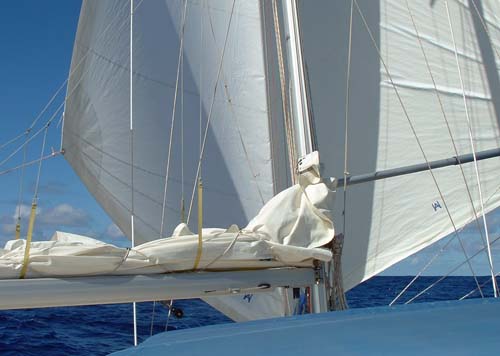
Line squalls will bowl in from astern, often accompanied by heavy rain and strong winds. Goose-winging with a poled-out jib and a main secured by a preventer, rounding up into the wind to put a reef in will be no fun at all.
Life will be more agreeable all round with the mainsail stowed away and twin headsail rig set - and a twin-luff groove headsail furling gear lends itself very nicely to this rig.


A Twin Headsail Rig for
Tradewinds Sailing

Most of us cruising types have twin luff groove headsail furling systems on our sailboats, which are ideal for tradewind sailing. But rather than hoisting two headsails at the same time, each in their respective luff groove, a better approach is to attach a good quality block to the head shackle on the top swivel and reeve a 6mm Spectra halyard through it with both ends tied off to the tack swivel on the furling drum.
The usual headsail can be hoisted and operated in the normal way and the second headsail hoisted only when needed.
rigging twin headsails on twin luff foil
When hoisting the second headsail, make sure that the luff groove is facing forward - if it isn't, a gybe will ensure that it is. If you try to hoist the sail with the groove facing aft, the wind will blow the sail around the foil and the resulting friction will be such that you won't be able to hoist the sail.
With two headsails set in this way, they can be furled simultaneously if a squall comes through.
In the absence of a spare luff groove, the second headsail can be set flying, but this is likely to induce more rolling than the twin-luff set-up. Either way, the twin headsails will be more stable if they are of similar size and supported by similar length poles.
Without a second pole, the boom can be squared off and the jib sheet passed through a block on its end. This though, is a poor substitute.


Self Steering on a Tradewinds Sailing Passage

You won't want to helm across several thousand nautical mile of ocean. You'll need some form of self steering to take you across...


Windvane Self Steering

Windvane self steering gears only work well if there's a decent flow of air over the vane. On a tradewind passage, the wind is likely to be pretty much dead astern, so the apparent wind speed will be less than the true wind speed.
For example, if you're bowing along at six knots with a 12 knot breeze blowing directly over the transom, the windvane gear will only feel a 6 knot wind over its vane. This is at the very limit of most windvane gears' performance, so you shouldn't rely too heavily upon them for your self-steering requirements on a tradewinds sailing passage.


Electronic Autopilot

Most skippers will choose this electronic steering system, perhaps as a back-up for the windvane gear or as their primary self-steering system. But it requires electrical energy to drive it, often quite a lot of it - which has to come from somewhere.


Sheet-to-Tiller Steering for Downwind Tradewinds Sailing

The main requirement for this approach is a tiller, which is becoming increasingly rare on modern yachts, as fashion demands that wheels are the thing to have now. OK, if you've got a centre-cockpit sailboat then you've little choice in the matter, but many aft-cockpit sailboats would be better off with tillers in my view. But don't get me started on the tiller versus wheel issue...
sheet to tiller self steering with twin headsail tradewind rig
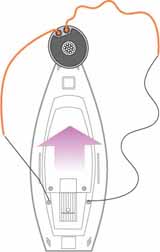
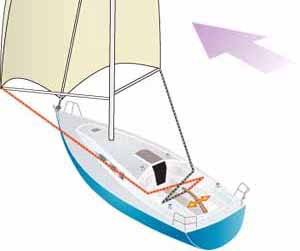
So let's assume that, like me, you've got an aft-cockpit sailboat with a tiller. With the twin headsail tradewind rig set, cross over the sheets in the cockpit through a pair of blocks and tie them off to the tiller.
There'll be a fair amount of fiddling around with the position at which you tie them off to get the balance right, particularly if your headsails are not quite the same shape and size.
This is done with the tiller between your legs, one eye on the compass, the other on the windex and a headsail sheet in each hand. An interesting experience for single-handers, but once set up this rig will take you downwind with little further tweaking. Don't forget that if the wind changes direction, so will your course.
Few of us would set out on a tradewinds sailing passage relying solely on sheet-to-tiller steering, but when all else fails.....
Artwork by Andrew Simpson


Keeping the Batteries Charged on a Tradewinds Sailing Passage

Larger cruising sailboats are likely to have a built-in generator to provide a reliable charge to their batteries when they need it, but without one of these you'll need to find some other way of charging your batteries. Yes, you can run the engine for a couple of hours each day to charge the batteries, but who wants to do that unless you have too?


Wind Chargers

Much like the windvane self-steering gear, the windcharger's performance is a function of the strength of the apparent wind. The stronger the apparent wind the faster the blades will spin, and the higher the speed of rotation the more of those precious little amps will be deposited into the battery bank.
So you'd be wise not to expect too much from your wind generator on a tradewinds sailing ocean passage.


Solar Panels

Being in the tropics, as that's where you'll find the tradewinds, there'll be lots of sun high in the sky. Perfect for solar panels; they'll perform at their best. But in the tropics the nights are long, when solar panels don't perform at all.


Towed Generators

These really kick out the battery juice at any time of the day or night, providing you've got reasonable boat speed through the water. However much of it you've got though, a towed generator will reduce it by up to half a knot, or at a cost of up to 12 nautical miles a day.
Large fish have been known to consider towed generators as part of their diet.
And if the rotating line of your towed generator cosies up to your trolling line, the resultant tangle will stay in your mind for a long time...


Shaft Generators

As their name suggests, these are driven by your engine's propeller shaft. Under sail, and with the engine turned off and in neutral, the normal function of the propeller is reversed. Now the water flowing through it turns it and the shaft, thus driving the prop shaft generator.
They generate a useful charge for the batteries, but a propeller turning freely with the engine off creates a lot of drag. More so than a towed generator, so you can expect a significant reduction in boat speed.
Many of us have installed either a folding or a feathering propeller to reduce drag to a minimum when the engine's not in use - in which case a prop shaft generator wouldn't work at all.
Scribed by Mary Swift

Monday, 8 January 2018

The MoM World - Sail Round The World


I believe a lot of you guys might be wondering why my blog was named The MoM World ? MoM actually stands for "Mecca of Marine" World or Centre of Marine World. Hence the full title should read "The Mecca of Marine World". At one point of my life, I want to sail round the World. It's obvious that it would need a lot of Capital : be it monetary, knowledge and material in order to do such an adventure. A lot of planning. A whole lot of preparation. A lot of research. Understanding the World weather routing, seasonal wind, currents, typhoon and hurricanes seasons and other natural phenomena. The typical motto : "Be prepared for the Worsts and Hope for the Best".

So, in preparing for my round the world trip.....I will take you with me doing the brainstorming, researching into World weather patterns, ocean currents, seasons to avoid in certain places, selecting and buying a suitable sail boat, boat rationing, learning to sail, navigation, Ocean and Coastal Rule of the Road, Port and Custom Clearance, Health Quarantine and a whole lot of other stuff that I need to prepare prior undertaking the task of circumnavigating the earth. It's a daunting task but with the philosophy "WE CAN" with the blessing of God Almighty's nothing is impossible.

What I need from you guys is to provide relevant support in terms of ideas, past experiences, especially local knowledge about practises or peculiar weather patterns near your area will be of great help.

Here we Go..........

GLOBAL WIND PATTERNS
https://www.google.com/search?q=global+wind+patternsobal Wind Pattern


By simply clicking on the URL above, the diagram illustrate the global High pressure and Low pressure areas. In principle, Wind blows from High Pressure to Low Pressure. Whenever there is pressure differential, there is wind. If a certain area does not have wind, that means there is no pressure differences. This is what we called "equilibrium" or calm. Note: Many of you may be confused with the wind direction. For Wind : when a direction of wind is mention - it means that it's the direction where the Wind is coming from. In the event of Current (Sea current or River Current) it means that it is the direction where the Current is setting to. These two conventions MUST never be confused and forms part of basic meteorology. 

However, there are local coastal and hill winds that are more complex than the basic High and Low pressure differences. Sometimes there are also the merging of two or three wind forces that causes turbulence. There are also the seasonal Hurricanes, Typhoons, Cyclones or Tornadoes. The principles remain the same. But they are in Grand scale.

Next we move to the Trade Wind scenario, where the following URL will provide comprehensive information that we are looking for : http://bio1151b.nicerweb.net/Locked/media/ch50/wind.html
From this diagram, the term "Coriolis" was used for the first time. This is actually the effect of the earth rotation from West to East causing a "shift" in the wind direction. This effect is called the Coriolis Effect.


You will notice that in the Northern Hemispere, the wind patterns move in a clockwise direction, where as in the Southern Hemishere, it is anti-clockwise. It is interesting to note that, when Christopher Columbus set sail from Spain, he intends to go to India but ended up in the West Indies -his ship's was carried away by the strong Easterly Trade Winds.

The Coastal wind patterns are caused by the unequal heating of the land mass and the sea. The land heats up faster than the sea water. As such, the hot air from the land rises which causes a pressure difference, thus cooler air from the sea blows to the coast land to replace the lower air pressure area left by the rising hot air. Similarly, in the evening when the coast land cools off earlier than the sea, the land breeze fills up the lower air pressure area left by the warm air still rising in the sea at night. This kind of sea breeze and land breeze can be felt if you are sailing close to the coastal waters. There is also the Katabatic wind which affect areas near mountains and hillslope. We are not going to cover this.

The other form of winds are the disturbances caused by Hurricane, typhoon, and tornadoes or we  generally called as storms ! Their scientific name is Tropical Cyclone. They are called differently in various part of the world. In Asia/Far East - Typhoon, In America/West Indies - Hurricane, Australia/Indian Ocean - Cyclone. Their typical paths are as shown in the drawing below.

Shows origin and typical path of Storms

These storms are formed in the warm areas near the Equator, which are like an engines that requires warm air and moisture as their fuel. It normally covers a large area. These warm air and moist air rises quickly upward, it created a low air pressure below it, and are quickly replaced by cool air. As the process continue, the cool air and moist air get heated up to due to the vastness of the area, as more air rises it forms large cumulonimbus clouds. As the process continues, it created a swirling effect "counter-clockwise direction" in the Northern Hemisphere and "clockwise" in the Southern Hemishere. The whole system of swirling winds, cloud and moisture grows as they are being fed by the ocean's heat and moisture evaporating from the surface. 
How the swirling effect was created

It gathers momentum, and moved in a Westerly to Northwesterly direction in the Northern Hemisphere seeking more warm water and moist air to survive. The whole system moves at approximately 10 to 15 knots. It normally weakens once it reaches landfall. Without her fuel i.e. warm air and moist air, it will not survive !There have been cases whereby, it was still causing havoc 100 to 200 miles inland. Those happens because of the vastness of the system. It can covers an area of 400 to 500 mile. Like Hurricane Irma, it could also cover the states of Michigan, Pennsylvania, West Virginia, Kentucky and North Carolina at once. That was when she was matured. In her earlier stage, prior passing West Indies, she was more like the state of Texas.

Hurricane "Irma"prior hitting Virgin Islands

Now let's take a look at the prevailing Ocean Currents. Looking at the way nature was formulated, it seems almost obvious that sailing East to West is the recommended way of traversing the Earth. With the Earth rotating from West to East, and taking into account time zones, it will be to your advantage going westwards. If you compare the Ocean surface currents, and the trade winds, they seems to match. What I mean is you need to catch both inorder to get the favourable speed through the water. Although the yacht has a small water plane area, but it's enough to be affected by ocean current. See the diagrams  below of the Surface Current of the World And match it against the prevailing Trade Winds.....
Surface Current of the World
Prevailing Trade Winds

And match it against the prevailing Trade Winds.....

However, you need to be mindful when to enter certain areas and when to get out of it. Otherwise, your boat will be dragged along to unwanted territories. Such as head-on with the Antartic Circumpolar Current near South Africa and also not to far up North or you'll be encountering with the pirates of Somalia. I am visualizing coming out of Malacca Strait, and heading South to about Latitude 15 Degrees South before heading West joining the South Equatorial Current and catching the South Easterly Trade Wind. I would be targeting the Northern tip of Madagascar Island and into the Mozambique Channel keeping close to the shore to join the Agulhas Current and after turning the Cape of Good Hope joins the Benguela Current and so on. 

To be Continued.......

Sunday, 7 January 2018

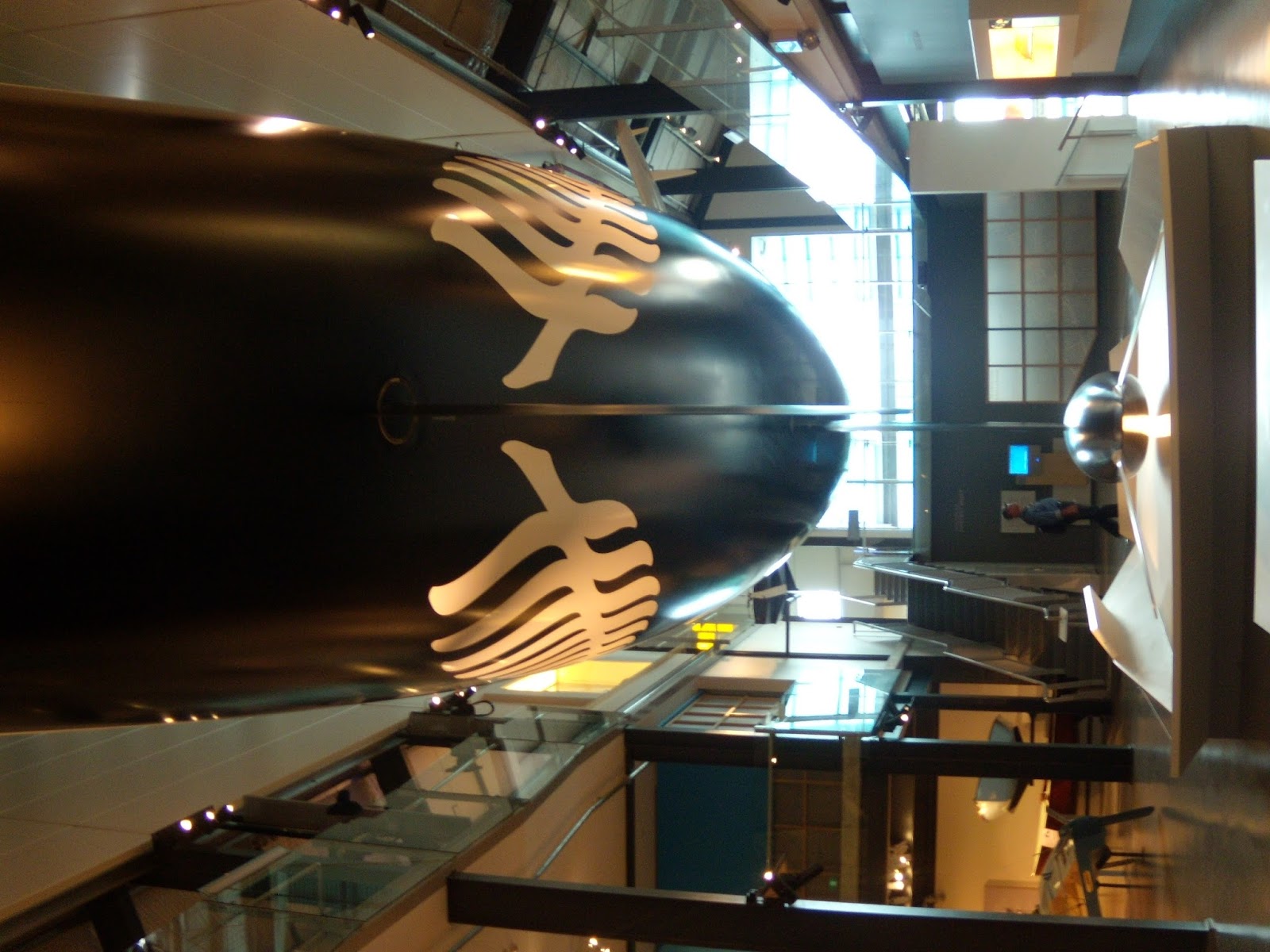
The Team New Zealand Boat being preserved in a specially designed Museum

The Centre Keel Bulb & Stabiliser seen from the stern


The Centre Keel with Bulb & Stabiliser seen from the Bow
This is the actual boat that won the America's Cup. The way they preserved this pride of their country is commendable. Sad to say in our homeland, once our pride "Jalur Gemilang" (that circumnavigated Solo Round the World - assisted) was left to rot in Langkawi Island. What a waste - we didn't appreciate the sacrifice made by a Malaysian Sailor in order to put Malaysia in the World Maritime Map. Our forefathers used to be great sailors. I hope more Malaysians will come forward to venture & explore in our Marine Industry.

Sheer Sailing Pleasure onboard Americas Cup Racing Yacht (Part 3)


THE AC35 - CLASS YACHT IN ACTION

NZ AC35-Class Yacht

It's been a few years since I have written anything, due to work commitment and hectic schedules. To recap the trip that I took on the "Americas Cup" sailing boat, it was a very memorable experienced. It doesn't aged, and felt as if I've just taken the trip yesterday.

As the boat cruised through the bay (or the Great Sound) we saw some beautiful houses and mansions stretched along the sea front. A few notable Yacht Clubs were also noticeable, namely : Royal Akarana Yacht Club, Tamaki Yacht Club and Richmond Yacht Club Inc.

Look how the weather quickly deteriorated ...... cloudy and overcast. We were notified by the skipper (Captain) that the wind might blow a lil' bit stronger and cautioned us to hold on to something solid. True enough, the wind started to increase in strength as we approached the open sea. Together we tightened the slack on our jib and main sails. We were zooming thru' the water. "What a Speed" - "Speedy Gonzaleez" so exhilarating.....I told myself "This is once-in-a-lifetime experience". I was told this elite yacht is worth over NZ$1 million, a racing machine that is usually the domain of professional sailors.

The trip back to Waitemata Harbour was equally enjoyable. We got the glimpse of the new NZ AC35 - Class Yacht being put to test at the Great Sound. On her top speed she seemed to glide high on her centreboard keel. Pretty amazing !
She seems like flying over the water !

The two hour trip was well worth it. It costs NZ$155 for this two hour sailing experience. Any landlubbers can experience what it's like to crew an elite yacht. Normally there are 11 crew in a racing team. This time around we have only 5 of them. The balance is complemented by the "landlubbers". There's no pressure to participate - it's fine to sit back and enjoy the sailing - but for those who want to get on the action, there's plenty to do. Work up a sweat on the grinders (winches), learn the art of tacking, steer the boat, or simply keep a lookout for approaching ships and boats.


Homeward bound into the harbour


Secured once again at the waterfront

It was two hours well spent and will continue my next episode soon.......

Saturday, 6 January 2018

Auckland Harbour and Surrounding Bay


Pictures of Boats & Yachts at Auckland Harbour


Looks like a "flying" Yacht


Beautiful Auckland in the Background

AC45-Class Yacht in action.